
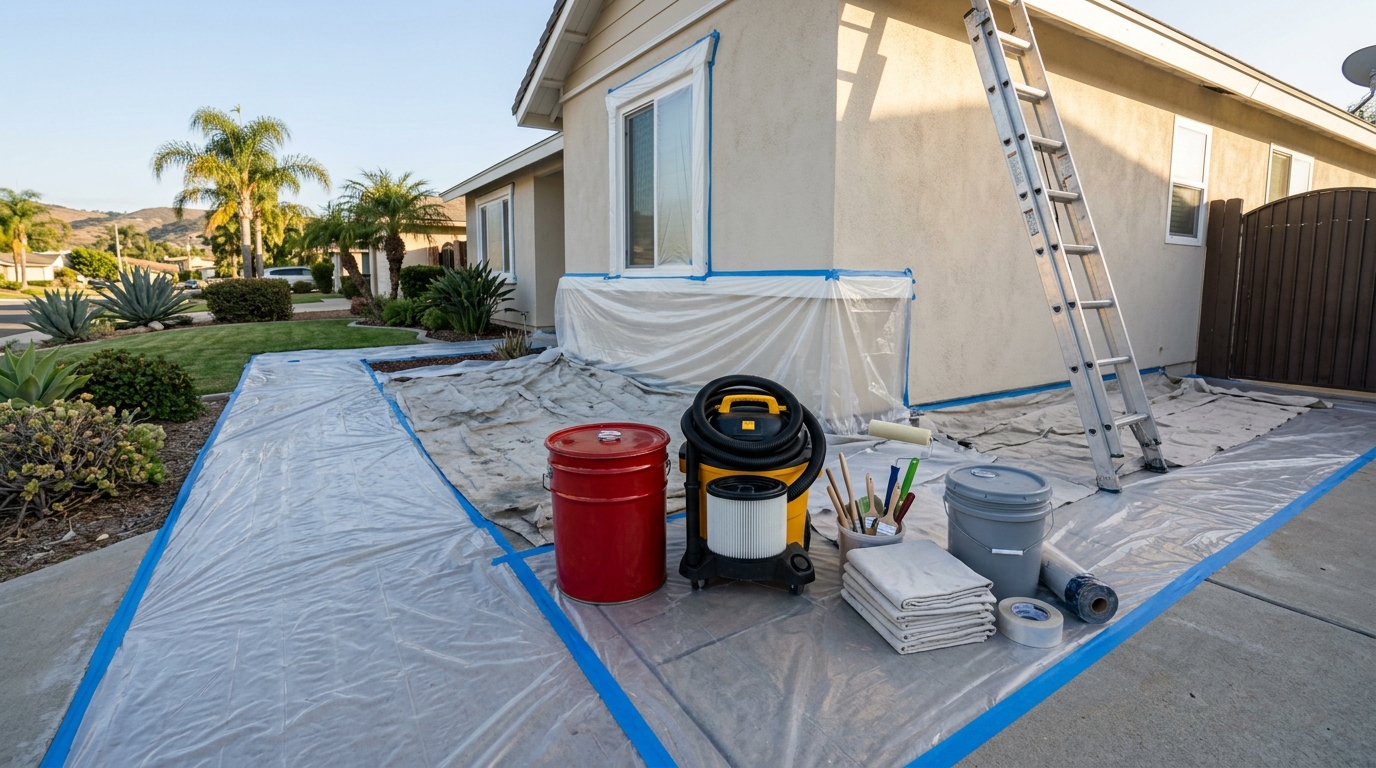
Site protection and daily cleanup are the setup and housekeeping steps that keep paint dust, chips, and debris inside the work area and out of the rest of your home or yard. On a professional painting job, that means sealing off the work zone with taped-down plastic sheeting, covering floors or ground well past the surfaces being painted, storing solvent-soaked rags and waste in covered fire-resistant containers, clearing debris at the end of each day, and cleaning the area until no residue remains. The exact requirements depend on two things: whether federal lead-safe rules apply, which happens in most homes built before 1978, and the ordinary jobsite housekeeping duties that OSHA places on every painting crew regardless of lead. At Tony's Painting in El Cajon, we treat containment and cleanup as part of the scope, not an afterthought, because a controlled site protects your family, your finishes, and the quality of the work itself.
How do painters contain the work area indoors versus outdoors?
Work-area containment is the physical barrier system, plastic sheeting, taped seams, and covered surfaces, that isolates the area being painted so dust and debris cannot migrate into clean space. Indoor and outdoor jobs use the same idea but different footprints, because gravity and airflow behave differently in each setting.
For interior work in a lead-regulated home, the floor, including installed carpet, gets covered with taped-down plastic sheeting extending six feet beyond the perimeter of the surfaces being renovated, or a greater distance if that is what it takes to contain the dust (the EPA's "What is the work area?" guidance). Windows, doors, and ducts inside the work area are closed and covered, and the HVAC system is shut off so it does not pull dust through the house.
For exterior work, the ground is covered with plastic sheeting or other disposable impermeable material extending ten feet beyond the perimeter of the surfaces being renovated, or enough to catch falling paint debris, whichever is greater, unless the property line prevents the full ten feet, per the EPA's exterior plastic-sheeting guidance. Vertical containment, such as barriers or shrouding, can reduce the required horizontal footprint on either interior or exterior work when neighboring buildings are close.
| Dimension | Interior containment | Exterior containment |
|---|---|---|
| Minimum covering | Floor covered 6 ft beyond the work surfaces, or enough to contain dust | Ground covered 10 ft beyond the work surfaces, or enough to catch debris |
| Vertical containment | Floor covering may stop at a sealed floor-to-ceiling barrier | Ground covering may stop at the vertical barrier if it is under 10 ft away |
| Extra precautions | Windows, doors, and ducts closed or covered; HVAC off | Vertical containment or equivalent used when other buildings are close |
The footprint minimum is a floor, not a ceiling. The EPA treats containment as a performance standard, meaning a crew has discretion to set up more than the minimum when a room's layout or wind conditions demand it.
What daily housekeeping and waste storage does OSHA require on every site?
Every painting jobsite, lead or not, carries housekeeping duties under federal workplace safety rules. OSHA's construction housekeeping standard requires that during construction, alteration, or repair, scrap lumber, debris, and other refuse be kept cleared from work areas, passageways, and stairs (OSHA 1926.25). This is a continuous duty, not just an end-of-project sweep, which is why a well-run crew stages waste and clears clutter as the day goes on.
Waste storage carries its own rules. OSHA requires covered containers for garbage and for oily, flammable, or hazardous waste, with separate collection for waste, trash, and used rags. Solvent waste, oily rags, and flammable liquids must be kept in fire-resistant covered containers until they are removed from the worksite, per OSHA 1926.252. This matters more than it sounds: oily rags can self-heat and ignite, which is exactly why the covered fire-resistant container rule exists.
Flammable liquid handling is regulated too. Any leakage or spillage of flammable liquids must be disposed of promptly and safely under OSHA 1926.152. OSHA interpretation guidance also sets storage limits: no more than 25 gallons of flammable or combustible liquids may be kept in a room outside an approved storage cabinet (an OSHA interpretation letter). For a typical San Diego repaint these thresholds are rarely approached, but the covered-container and prompt-cleanup duties apply to every job, every day.
How do pre-1978 homes change the containment and cleanup rules?
Homes built before 1978 trigger a stricter federal rulebook because they may contain lead-based paint, which was banned for residential use that year. The EPA's Renovation, Repair and Painting (RRP) Rule requires that anyone paid to disturb painted surfaces in pre-1978 homes, childcare facilities, and preschools be certified and trained in lead-safe work practices that minimize occupants' exposure (the EPA's Lead Renovation, Repair and Painting Program). These practices exist to control dust migration and require cleaning of the work area to protect occupants.
The rule applies to compensated, paint-disturbing work above minimal thresholds. A firm has several choices: assume lead-based paint is present and follow the RRP work practices with no testing required, or test the surfaces and, if lead is found, follow the rule, per the EPA's testing guidance. A crew may skip RRP practices only when it proves lead is absent.
Under RRP, cleanup is spelled out. At the end of each work day and at the conclusion of the renovation, collected waste must be stored under containment, in an enclosure, or behind a barrier that prevents dust and debris from escaping the work area, and then disposed of properly. Following the renovation, the work area must be cleaned until no dust, debris, or residue remains (the EPA's comprehensive-renovation guidance). If your home predates 1978, ask any contractor how they plan to handle containment and cleanup before the first surface is scraped. Our licensed and insured painting contractor overview explains why certification matters on these projects.
How does a job get verified clean at the end (cleaning verification versus dust clearance)?
A lead-regulated job closes out with one of two distinct proof-the-area-is-clean methods: the EPA cleaning verification procedure or laboratory dust-lead clearance testing. They are different mechanisms, and the RRP Rule states that if dust clearance testing is performed, the cleaning verification requirements do not separately apply.
Cleaning verification is a visual comparison. The contractor uses disposable cleaning cloths to wipe the floor and other surfaces of the work area, then compares those cloths to an EPA-provided cleaning verification card to judge whether the area was adequately cleaned (the EPA Renovate Right insert). If a wet-wipe cloth does not match the card, the crew re-cleans the surface with a dry, electrostatically charged, white disposable cloth designed for hard surfaces, then repeats the check. This is the standard closeout for most RRP renovation jobs.
Dust clearance testing is quantitative. Rather than a visual card comparison, it uses laboratory-analyzed wipe samples measured against dust-lead standards. Clearance testing generally governs when an abatement project or a HUD or contractual clearance requirement is in play, and in those cases the RRP cleaning verification card is not separately required.
| Closeout method | What it is | When it applies |
|---|---|---|
| Cleaning verification | Visual comparison of wipe cloths to an EPA card | Standard RRP renovation closeout |
| Dust clearance testing | Lab-analyzed wipe samples against dust-lead limits | Abatement or HUD/contractual clearance jobs |
Skipping the required closeout step is a common enforcement failure, so confirm which method your project uses. For a broader look at how a job moves from setup to sign-off, see our painting process overview.
What should San Diego homeowners confirm before work starts?
Before a crew opens a single can of paint at your San Diego or El Cajon property, confirm four things that directly affect protection and cleanup. First, ask how the work area will be contained and how far the covering will extend past the surfaces being painted, since the honest answer references the six-foot interior and ten-foot exterior footprints as minimums, not fixed limits.
Second, if your home was built before 1978, confirm the contractor is set up to follow lead-safe RRP practices or has documented that lead is absent. This single fact changes the entire containment, waste-handling, and closeout picture, and it is worth resolving in writing.
Third, ask how solvent-soaked rags, paint waste, and flammable liquids will be stored during the job. The correct answer is covered, fire-resistant containers kept until removal, with debris cleared from walkways and stairs as the work proceeds.
Fourth, confirm how the crew will prove the area is clean at the end, whether by cleaning verification or, for abatement and clearance-governed work, by dust clearance testing. A contractor who can answer these plainly is describing the same standards we build into our scopes at Tony's Painting. If you are still comparing bids, our guide on how to choose a painting contractor in San Diego walks through what else to verify.
Frequently Asked Questions
How far does floor covering need to extend beyond the area being painted?
For interior lead-regulated work, the floor must be covered with taped-down plastic sheeting extending six feet beyond the perimeter of the surfaces being painted, or a greater distance if that is what it takes to contain the dust. The six-foot figure is a minimum, and a crew may extend it when a room's layout requires more coverage.
How is exterior ground containment different from interior floor covering?
Exterior ground containment extends ten feet beyond the perimeter of the surfaces being renovated, compared to six feet indoors, or enough to catch falling paint debris, whichever is greater. The larger outdoor footprint accounts for debris falling from height. If the property line prevents the full ten feet, the covering stops at the line, and vertical containment can reduce the required horizontal distance.
How should a painting crew store oily rags and solvent waste on site?
Oily rags, solvent waste, and flammable liquids must be kept in fire-resistant covered containers until they are removed from the worksite, under OSHA 1926.252. Separate covered containers are required for garbage and for oily, flammable, or hazardous waste. Covered storage matters because oily rags can self-heat and ignite if left in an open pile.
When do lead-safe RRP containment and cleanup rules apply to my home?
Lead-safe RRP rules apply when a paid contractor disturbs painted surfaces above minimal thresholds in a home, childcare facility, or preschool built before 1978. A firm either assumes lead is present and follows the rule with no testing, or tests and follows the rule if lead is found. The rules can be skipped only by proving lead is absent.
What is the difference between cleaning verification and dust clearance testing?
Cleaning verification is a visual method where the contractor wipes surfaces with disposable cloths and compares them to an EPA cleaning verification card. Dust clearance testing is a quantitative laboratory wipe test measured against dust-lead standards. They are separate options: when dust clearance testing is performed, the cleaning verification requirements do not separately apply.
How thick does containment plastic sheeting have to be?
The EPA does not set a fixed thickness or mil rating for containment plastic sheeting. Instead it uses a performance standard: the sheeting must isolate the work area, prevent dust and debris from escaping, and remain untorn during the job. A crew chooses a gauge sturdy enough to meet that standard for the specific surfaces and conditions.