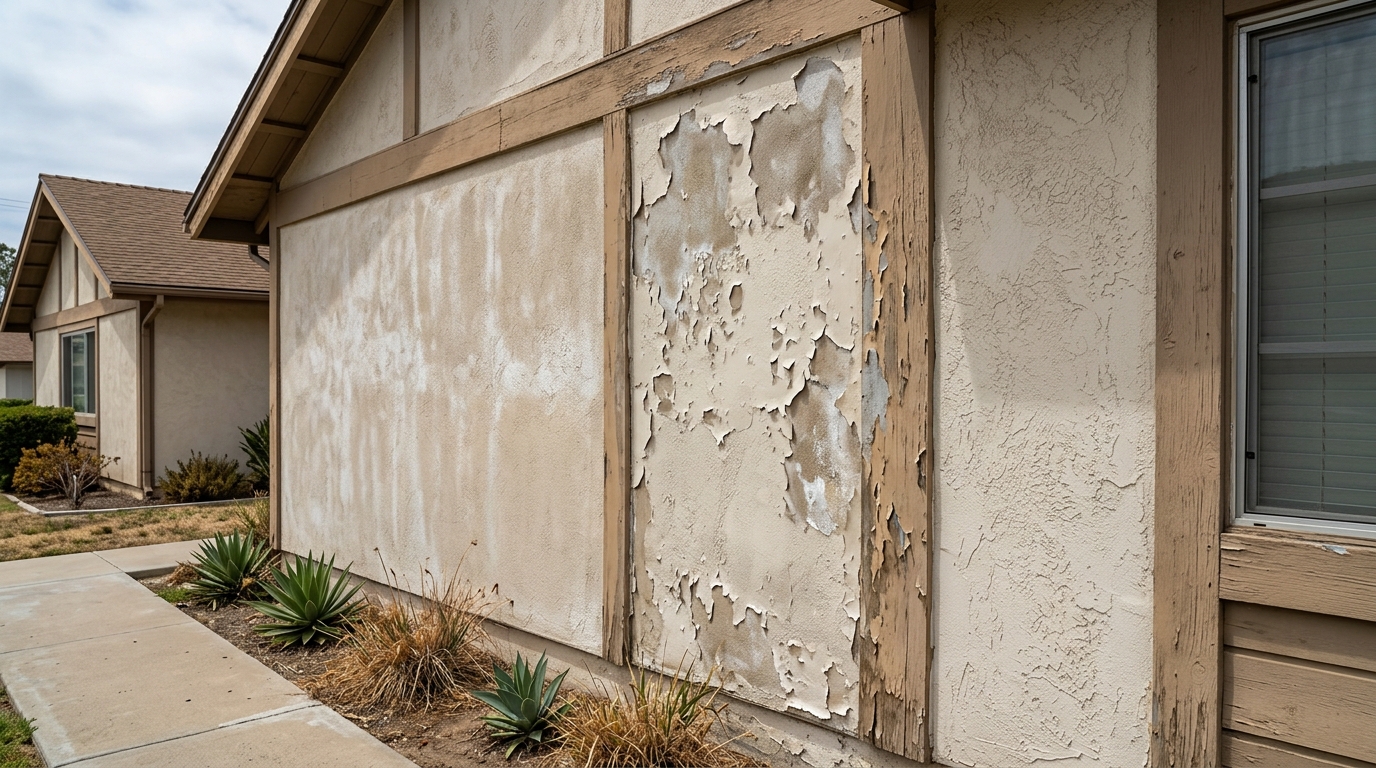
The difference comes down to whether the paint film is still doing its job. A cosmetic issue is an appearance-only change where the film still adheres and protects the surface underneath, such as fading, gloss loss, surface dirt, or light chalking. Visible wear is a loss of film integrity or a sign that moisture is reaching the substrate, showing up as peeling, flaking, blistering, or cracking. That distinction decides your whole repair path. A cosmetic surface only needs cleaning and a fresh coat. Wear means you have to find and correct the cause first, then scrape to a sound edge, prime, and recoat. Repainting over unresolved wear is the single most common and costly mistake in home maintenance, because the new coat fails in the same spot on roughly the same timeline. Before choosing paint, diagnose the symptom. The symptom is telling you what is happening beneath the surface.
How Can You Tell Whether the Paint Film Is Still Adhering or Failing?
Adhesion is the deciding factor. As ASTM D3359-23 puts it, a coating can only protect or decorate a surface as long as the film stays bonded to the substrate. So the first question on any wall is not "does this look tired" but "is the film still stuck." If the paint lifts, flakes, or blisters, the bond has failed and no amount of topcoat will restore it. If the film is intact and simply looks aged, you are dealing with a cosmetic condition.
The objective way to check bond strength is a tape adhesion test, a standardized method where a specific pressure-sensitive tape is applied over the coating and pulled off to see how much film comes away. ASTM D3359 covers two approaches: an X-cut test and a crosshatch grid test, both documented in the D3359-23 standard. Method A, the X-cut, is intended for coatings thicker than 125 micrometers, roughly 5 mils; Method B, the crosshatch, is for thinner films. The result is graded on a scale, and in the crosshatch approach the rating reflects the percentage of grid squares that detach, so more removal means a worse score.
Fading and chalking are different from failure. Chalking is a fine powder that forms on the surface as ultraviolet light, moisture, and oxygen break down the paint's binder resin. ASTM D4214 grades chalking on a photographic scale where 10 means no chalking and 0 means heavy pigment transfer, as defined in the D4214 test methods. Light chalk transfer with an otherwise sound film is cosmetic. Heavy chalking that signals the binder itself is spent moves the surface toward wear.
| What you observe | Film status | Correct response |
|---|---|---|
| Fading, gloss loss, light chalk | Intact and adhered | Clean the surface, then recoat |
| Peeling, flaking, blistering | Adhesion lost | Fix the cause, scrape to sound edge, prime, recoat |
| Heavy chalking, binder failure | Degrading | Grade with D4214, then plan repair |
If you are weighing a full exterior project, our guide to [the signs a San Diego home needs an exterior repaint](signs a San Diego home needs an exterior repaint) walks through how these symptoms read on a real elevation.
Why Does Moisture-Driven Wear Need Source Correction Before Any Repaint?
Moisture is the most common cause of premature paint failure on wood, so when the failure pattern points to water, the repair starts at the water source and not at the wall. Purdue Extension's paint failure guidance explains that outside walls take on water from rain and dew, and that "unseen" moisture moving from inside the house outward is just as serious, penetrating the paint film and producing cracking, peeling, discoloration, and premature failure. If the moisture keeps coming, the coating keeps failing.
That is why source correction comes first. For moisture-driven blistering, the foundational work is improving bathroom exhaust, ducting range hoods to the exterior, addressing leaks or condensation, and sealing trim with flashing and caulk. Repainting without controlling the moisture source means the fresh film blisters in the same locations on the same timeline. Eliminating the moisture problem is the only practical way to prevent moisture blisters, and the source has to be identified and removed to avoid escalation into wood decay, rot, and lost insulating value.
Not every blister is a moisture blister, which is why the timing of the symptom matters. Temperature blisters, for example, form only in the last coat of paint and appear within a few hours to one or two days after painting. A blister that shows up months later in a bathroom wall or under a leaking window is a different signal, and it points to water rather than heat.
Understanding this order also affects how often a home realistically needs repainting. Our overview of [how often a San Diego home needs repainting](how often a San Diego home needs repainting) covers why coatings that fail early almost always have an unresolved cause underneath.
When Does Wear Signal Substrate Decay Risk on San Diego Wood and Trim?
Wear on wood can mean the substrate itself is at risk, not just the coating. When moisture gets trapped behind a film on fully exposed wood, drying is slowed and, as the USDA Forest Products Laboratory Wood Handbook explains, the wood's moisture content can approach the range where decay fungi become active. At that point the problem is no longer paint; it is the wood.
This failure shows up most often on the most exposed wood on a property. The Forest Products Laboratory notes it typically appears on painted fences and porch railings that face full weather, where the film both traps water and blocks drying. On homes across El Cajon and San Diego, that translates to sun-baked south and west elevations, fence pickets, railings, fascia, and window trim, the components that take the most direct exposure. When one of these areas peels while sheltered areas hold, treat it as a wood-condition question, not only a paint question.
The finish you choose changes this equation. A film-forming paint blisters and peels when moisture reaches the wood because it forms a continuous surface layer that water can lift. Penetrating finishes behave differently. Purdue and USDA guidance on exterior wood finishes explains that semitransparent penetrating stains soak into the wood, stay porous, and do not form a surface film, so they will not blister or peel even if moisture gets into the wood. That is why fences and railings often perform better with stain than with film paint.
If you are deciding between the two for a fence, our comparison of [whether to paint or stain a San Diego fence](whether to paint or stain a San Diego fence) applies this directly, and our notes on [the best paint for the San Diego climate](the best paint for the San Diego climate) cover coating selection for exposed surfaces.
How Can Disturbing Worn Paint on a Pre-1978 Home Trigger the EPA RRP Rule?
If your home was built before 1978, repairing worn paint can turn into a federally regulated activity, because the surface may contain lead. The EPA's Renovation, Repair and Painting (RRP) Rule is a federal regulation requiring that anyone paid to disturb painted surfaces in pre-1978 homes, childcare facilities, and preschools be certified and trained in lead-safe work practices, as described by the EPA's RRP program. In general the rule does not apply to homeowners doing projects in their own pre-1978 homes, but it does apply to the contractor you hire.
The rule is triggered by the amount of paint disturbed, not by whether the work is cosmetic. EPA guidance on the RRP Rule states its requirements may apply when activities disturb more than six square feet of interior painted surface or more than twenty square feet of exterior painted surface in target housing or a child-occupied facility. Covered work includes modifying or repairing painted doors, walls, and ceilings, along with surface preparation such as sanding and scraping. In other words, the scraping and sanding that wear repair demands is exactly the activity the rule watches.
This is the practical reason the wear-versus-cosmetic distinction has legal weight on older homes. Cleaning and recoating an intact, adhered film without disturbing paint stays outside the trigger. But once you diagnose wear and begin scraping to a sound edge on a pre-1978 house, the six and twenty square-foot thresholds put the project into RRP territory. For an El Cajon home from that era, that means the repair should be handled by a certified painter using lead-safe practices, which is one more reason to diagnose accurately before any tool touches the wall.
Stucco surfaces raise their own repair sequence questions; our page on [stucco repair and exterior paint in San Diego](stucco repair and exterior paint in San Diego) covers how substrate condition drives the order of work.
Frequently Asked Questions
Can I just repaint over peeling or blistering paint?
No. Peeling and blistering mean the film has lost adhesion, so a fresh coat over it bonds only to failing paint and comes off with it. Repainting over unresolved failure is one of the most common and costly maintenance mistakes because the new coat fails in the same place, often faster than the last. Diagnose and correct the cause, scrape to a sound edge, prime, then recoat.
How do I know if chalking on my exterior paint is cosmetic or a sign of wear?
Chalking is a fine powder from ultraviolet, moisture, and oxygen breaking down the paint binder. Light chalk transfer over a film that still adheres is cosmetic and usually cleans off before recoating. Heavy chalking, graded near the low end of the ASTM D4214 zero-to-ten scale, signals the binder is spent and the surface is moving toward wear that needs more than a wash.
What is a tape adhesion test and how is paint adhesion graded?
A tape adhesion test is a standardized method for checking whether a coating is still bonded, where pressure-sensitive tape is applied over the film and pulled off to see how much detaches. ASTM D3359-23 defines an X-cut method for coatings thicker than roughly 5 mils and a crosshatch method for thinner films. The crosshatch rating reflects the percentage of grid squares that come away, so more removal means poorer adhesion.
Why does only one wall or one elevation of my house fail while the others hold?
When one wall fails and the rest hold, the condition that differs between them is the cause. That difference narrows the diagnosis before any repair is chosen. Common drivers are a hidden moisture source, sun and weather exposure, or prep failure at the last repaint. Intercoat peeling, the separation of new paint from the old coat, usually comes from inadequate cleaning of weathered paint and shows up within one year of repainting.
Does my El Cajon home built before 1978 need a lead-certified painter to repair worn paint?
Yes, in most cases. The EPA's RRP Rule requires that anyone paid to disturb painted surfaces in pre-1978 homes be certified and trained in lead-safe work practices. Wear repair involves scraping and sanding, and once that disturbs more than six square feet inside or twenty square feet outside, the rule applies. Cleaning and recoating an intact film without disturbing paint stays outside the trigger.
Will penetrating stain blister and peel the way film-forming paint does?
No. Penetrating stains soak into the wood, stay porous, and do not form a continuous surface film, so they do not blister or peel even when moisture reaches the wood. Film-forming paints lift and peel because water gets trapped under the continuous layer. This is why fences, railings, and other fully exposed wood often perform more predictably with a penetrating finish.