
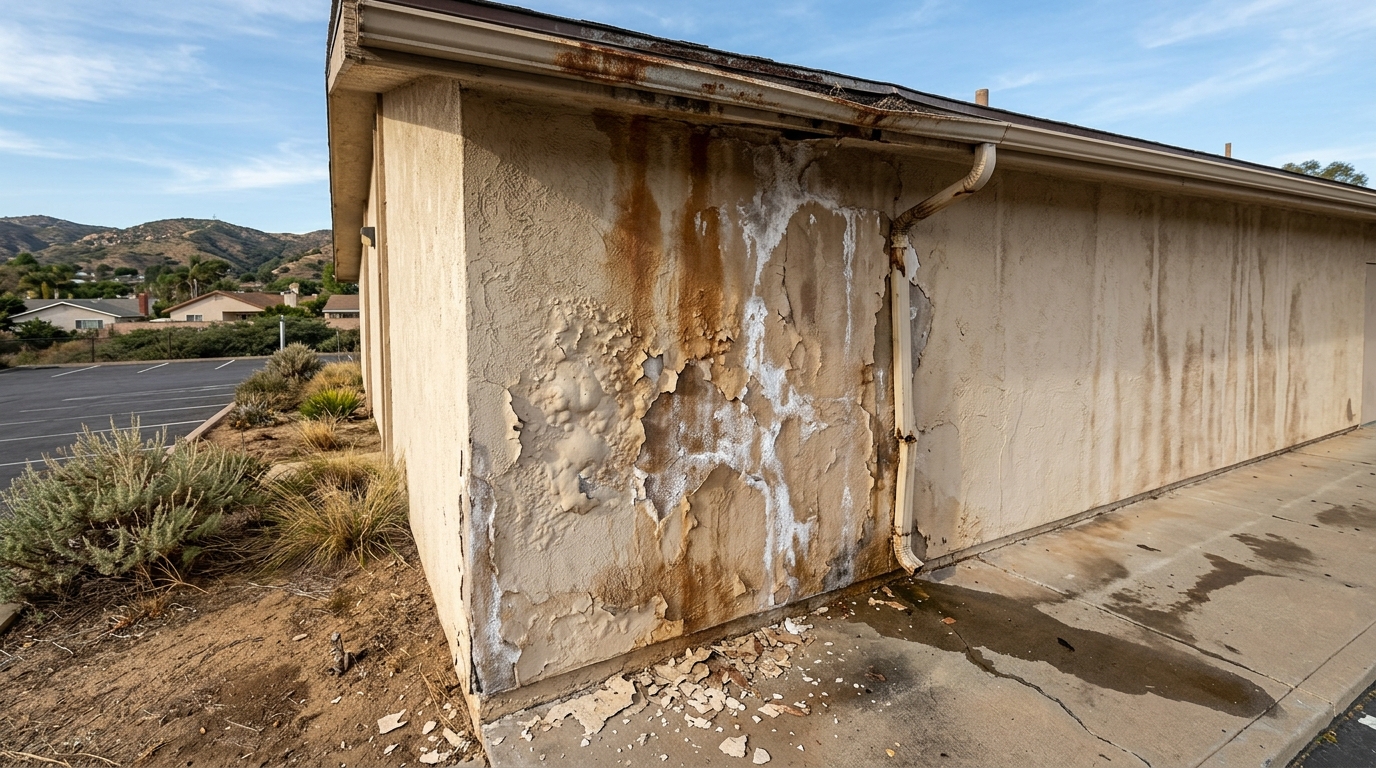
Water intrusion is liquid water or water vapor entering a building assembly, and moisture evidence is the visible or measurable trail it leaves behind: staining, blistering or peeling paint, efflorescence, a musty odor, or elevated moisture-meter readings. The single most important thing to understand is that these are symptoms of a water source, not paint defects to be covered. The US EPA states plainly that the key to mold control is moisture control, and that if you clean up mold without fixing the water problem, the problem will most likely come back. Paint applied over a wet or moldy surface is likely to peel, so the source has to be found and corrected first. In our exterior and interior work across El Cajon and San Diego, the failures we see most often trace back to a coating applied over an unresolved moisture source. Diagnose the water, dry the substrate, then paint.
What is moisture evidence?
Moisture evidence is any visible or measurable sign that water has entered or is passing through a building material. On a wall, that shows up as brown or yellow staining, paint that blisters or peels away in sheets, a chalky white crystalline deposit called efflorescence on stucco or masonry, mold growth, or a persistent musty smell. Framing that stays saturated and moisture-meter readings above normal are the hidden versions of the same story.
Not all of these mean the same thing. A single dried water stain from a plumbing leak that was repaired years ago is a corrected cosmetic issue. Active blistering that returns after every rain, or efflorescence that keeps reappearing on a garden wall, points to a source that is still feeding water into the assembly. The EPA notes that special attention should be given to areas that are hidden but that might have gotten wet, which is why a stain on drywall is often smaller than the wet area behind it.
In older San Diego County homes with stucco cladding, the classic pattern is efflorescence and peeling near grade, where groundwater and splashback keep the lower wall damp. If you are trying to sort a lasting problem from ordinary aging, our guide on visible wear versus a cosmetic issue walks through the distinction.
Why does diagnosis differ depending on how moisture moves through a wall?
Water reaches the inside of a wall four different ways, and each one demands a different fix. Treating a groundwater problem like a surface finish problem leaves the source active, which is why an accurate diagnosis matters more than the coating you choose.
- Bulk water is liquid water entering directly: rain penetration through cladding, roof and window leaks, groundwater, or flooding. This is the larger and fastest source, and it is what a water-resistive barrier, the drainage plane of the wall as the NAHB describes it, is built to shed. - Capillary transport is porous material wicking water upward or sideways. Building Science Corporation notes capillary transport through joints is significant only in gaps of less than about ⅛ inch (3 mm), but it readily occurs in concrete, clay brick masonry, and wood. The tell is a musty odor with a bottom wall plate that is saturated when the wall is opened. - Air-transported moisture is water vapor carried by air leaking into an assembly and condensing there. Airflow can move hundreds of times more moisture than vapor diffusion, so controlling air leakage matters far more than most homeowners expect. - Vapor diffusion is moisture moving slowly through materials along temperature and humidity gradients, condensing where the assembly drops below the dew point.
The reason this list matters to a painter is direction. A coating that seals the wrong face of a wall can trap moisture inside the assembly, which is a very different failure from a cladding that simply needs a better drainage detail.
Why does painting over an active moisture source fail?
Paint fails over an active moisture source because the water keeps moving, and the film cannot stop it. The US EPA is direct: do not paint or caulk moldy surfaces, because paint applied over moldy surfaces is likely to peel. Coating a wet or contaminated surface locks the problem underneath a film that then blisters, flakes, and lifts.
Efflorescence is the clearest example of this mechanism. The American Coatings Association explains that efflorescence is caused by water-soluble salts in the masonry substrate migrating by capillary action to the surface. If the paint film is not permeable enough and adhesion is not high enough, those salt deposits build up under the film and produce blistering, peeling, or flaking. In other words, the paint did not fail because it was a bad product. It failed because it was asked to hold back moving water and dissolved salt.
There is also a trapping failure. US HUD guidance on encapsulation states that components affected by water leaks or poor moisture venting should not be encapsulated unless the moisture problem is corrected first, and that an impermeable coating applied to the wrong side of a wall can blister as interior moisture passes through the envelope. Building Science Corporation identifies moisture, alongside sunlight, as one of the two major factors affecting how long a coating and its substrate last. Fix the water, and the coating you already trust starts performing the way it should.
How do painters and inspectors confirm a substrate is dry enough to coat?
Professionals confirm a surface is dry enough to paint by measuring moisture, not by looking at it. The core tool is a moisture meter, a device the EPA describes investigators using to find wet areas where mold may be growing across many types of building materials. A moisture meter reads volumetric water content indirectly through a substrate property such as electrical resistance or dielectric constant, so a reading takes seconds and does not require opening the wall.
Three things get measured: wood and framing moisture content, concrete slab internal relative humidity, and indoor air relative humidity. For wood-framed walls, Building Science Corporation research on high R-value walls found that sheathing moisture between 20% and 28% is risky and above 28% is very high risk, which gives a practical target to dry below before coating. For concrete slabs, the ASTM F2170 in-situ probe test measures internal relative humidity, and its own standard cautions that results indicate the slab's condition only at the time and locations tested. For the room itself, the EPA recommends keeping indoor humidity below 60%, ideally 30 to 50%.
| Measurement | What it checks | Practical target |
|---|---|---|
| Wood / framing moisture content | Sheathing and framing wetness | Below 20% before coating; 20 to 28% is risky per BA-1316 |
| Concrete slab RH (ASTM F2170) | Internal slab humidity | Valid only at test time and location |
| Indoor air RH | Room condition driving condensation | Below 60%, ideally 30 to 50% per EPA |
The 24-to-48-hour rule anchors all of this. The EPA states that if wet materials are dried within 24 to 48 hours after a leak, in most cases mold will not grow. A meter tells us when that drying is actually complete, rather than guessing from a surface that feels dry to the touch. On our repaint projects, this is also where stucco repair and drywall repair often come first, because damaged substrate has to be dried and restored before any finish goes on.
When should you clean water and mold yourself versus call a professional?
You can usually handle a small, dry, cosmetic cleanup yourself, and you should call a professional when the water is contaminated, the affected area is large, or the source is still active. The EPA sets a practical line: if the moldy area is less than about 10 square feet, in most cases you can handle the job yourself, but if there has been extensive water damage or mold covers more than 10 square feet, the work belongs to a professional.
Water type matters as much as size. OSHA advises assuming floodwater is contaminated unless proven otherwise, and when handling mold-contaminated material, using at minimum an N-95 NIOSH-approved respirator. OSHA also warns never to enter flooded areas or touch electrical equipment when the ground is wet. Clean water from a corrected source that dried within 48 hours is a very different job from sewage or floodwater.
| Situation | Do it yourself | Call a professional |
|---|---|---|
| Area affected | Under ~10 sq ft | Over ~10 sq ft or extensive damage |
| Water type | Clean, dried within 24 to 48 hrs | Sewage, chemical, or flood contamination |
| Source status | Found and fixed | Ongoing leak, groundwater, or hidden source |
If you correct the source, dry the area promptly, and the evidence is small and cosmetic, cleaning and repainting is reasonable. Anything larger, contaminated, or still leaking should be diagnosed and remediated before a coating goes anywhere near it.